


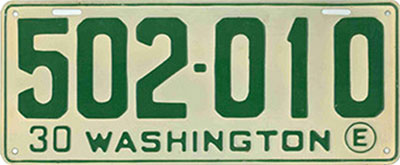
Restored specialty design plate
Overview
- Restored plate requirements.
- Vehicle requirements.
- Find out the initial cost for a plate.
- Visit an office, bring your application, plates, title and payment.
- Update your Good-to-Go! account, if needed.
1. Restored plate requirements
The plate must have been restored to its original design. It can't be a reproduction. The plate must match the year of the vehicle and be for general use.
For example, if you have a:
- 1967 Mustang, it must have a 1967 restored WA license plate
- 1956 Ford pickup truck, it must have a 1956 restored WA license plate
Before you can use restored plates, bring them into a vehicle licensing office so we can make sure they've been correctly restored and are the correct plates for the year of the vehicle.
The restored license plates
- Must be displayed on the rear of the vehicle. If you have a set of plates, you may put them on the front and back.
- You don't need to display month/year tabs on the plates.
- Are good for the life of the vehicle (don't need to be renewed yearly).
2. Vehicle requirements
The vehicle must be over 30 years old, see Collector Vehicle plates, or an antique (horseless carriage) manufactured or built before January 1, 1916, see Horseless Carriage plates, and
- Must have a current registration.
- Owned and operated as a collector vehicle.
- Capable of driving on the highway.
- May be driven:
- To and from auto shows, circuses, parades, displays, special excursions, and antique car club meetings.
- For testing purposes.
- For the pleasure of others without compensation.
- May not be used for:
- Commercial purposes or to carry a load.
- Regular transportation in the manner of a fully licensed vehicle.
- NEW: You have current vehicle liability insurance or a collector vehicle insurance policy for the restored vehicle.
- NEW: You own and have valid registration for a second vehicle you use for daily driving.
Note: These plates are not available for trailers.
3. Find out the initial cost for plates
Contact a vehicle licensing office to find out the total cost to get these plates.
4. Visit an office, bring your application, plates, title and payment
Visit a vehicle licensing office and bring the following:
- Collector Vehicle License Plate Application
- The restored plates
- The original title
- Payment
5. Update your Good To Go! account, if needed
If you have a Good To Go! electronic tolling pass, be sure to update the contact information on your account with the Department of Transportation:
- Online: www.wsdot.wa.gov/goodtogo/
- By phone: 866-936-8246
6. If you no longer use this vehicle
You must bring your plates to your local vehicle licensing office. If you no longer own the vehicle, you need to complete a Report of Sale. Learn more about disposing of old plates or selling your vehicle.